PNG to ICO converter · measured file check
PNG to ICO Converter: Does PNG Metadata Survive?
In our four-file test, PNG text and DPI chunks did not carry into the ICO downloaded from this converter. Each source had the same 64 × 64 pixels, but different metadata; all four ICO files were byte-identical. Use the PNG to ICO converter to make the icon, then inspect its saved layers if metadata matters to your workflow.
Convert a PNG to ICO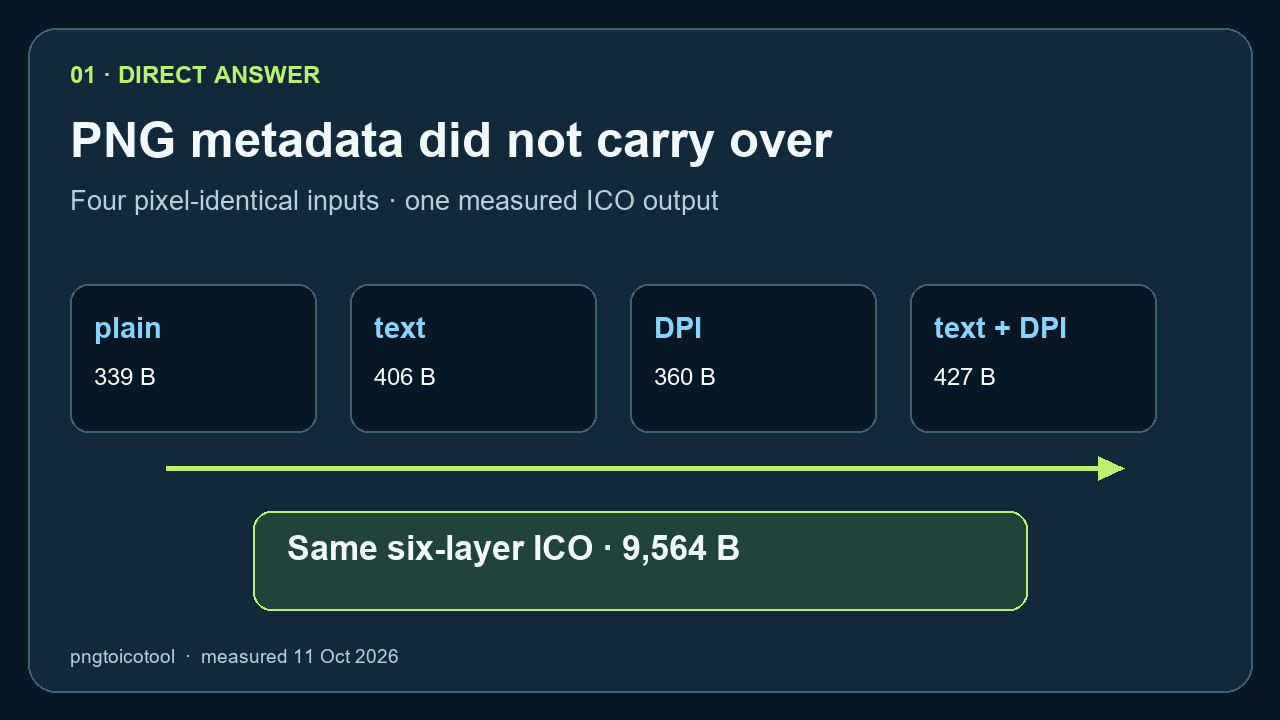
The plain, text-only, DPI-only, and text-plus-DPI inputs were 339, 406, 360, and 427 bytes. With all six sizes selected, every conversion downloaded a 9,564-byte ICO containing 16, 32, 48, 64, 128, and 256 pixel layers. All four downloads had SHA-256 6fd11144fec1b919656ee6d9bfe6f91ce4941648272e5d069e6fffcad26bbf0c. This is a result for these fixtures, browser session, converter version, and settings; it is not a promise about every converter or every PNG metadata type.
This experiment tested PNG tEXt and pHYs chunks. It did not test ICC profiles, EXIF, animation, arbitrary private chunks, or how another converter handles them.
What changed between the four PNG files?
We generated one simple 64 × 64 transparent badge, then saved it four ways without changing any decoded RGBA pixel. The plain file contained only IHDR, IDAT, and IEND chunks. The text variant added a tEXt description. The DPI variant added pHYs at 96 DPI. The fourth included both additions. The reproduction script decodes every input and asserts that all four pixel buffers match before producing the measurement CSV. Different source byte counts therefore reflect file structure, not a different icon drawing.
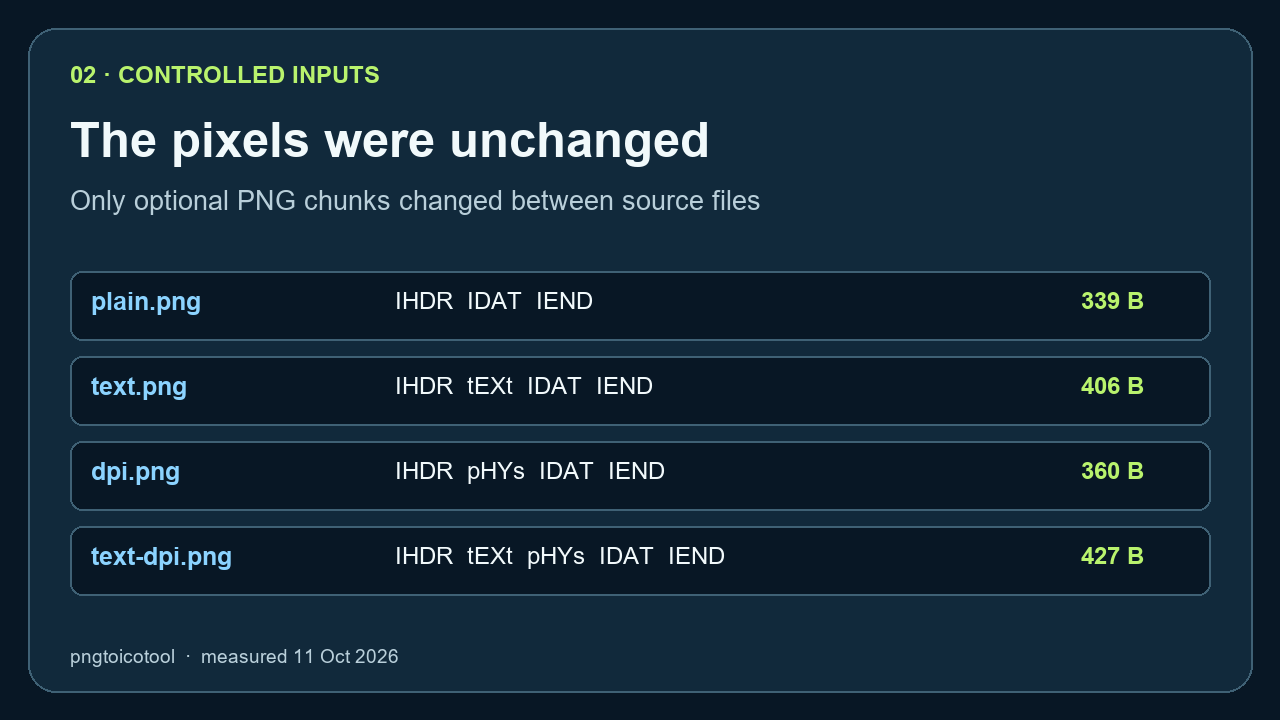
| PNG input | Source bytes | Optional chunks | Decoded pixels |
|---|---|---|---|
| plain.png | 339 | none | same 64 × 64 RGBA pixels |
| text.png | 406 | tEXt | same 64 × 64 RGBA pixels |
| dpi.png | 360 | pHYs | same 64 × 64 RGBA pixels |
| text-dpi.png | 427 | tEXt + pHYs | same 64 × 64 RGBA pixels |
What did the downloads contain?
On 11 October 2026, we selected each file in the public browser-local tool and left its six size checkboxes selected. The on-page status reported a six-layer download for each input. We saved and parsed all four ICO files rather than treating that status as the only proof. Each ICO directory listed 16 × 16, 32 × 32, 48 × 48, 64 × 64, 128 × 128, and 256 × 256. Each embedded image began with a PNG signature. The embedded PNG chunk lists contained IHDR, IDAT, and IEND only; neither tEXt nor pHYs appeared in the six payloads in this run.
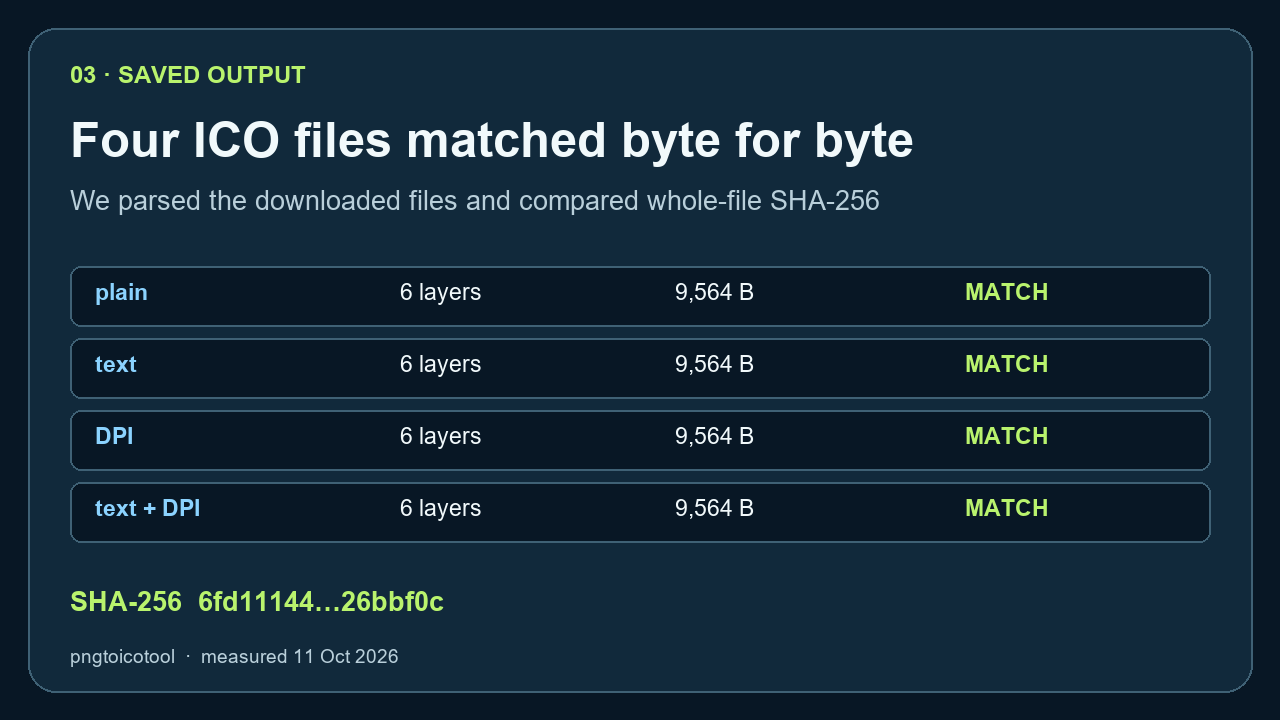
The stronger comparison is whole-file SHA-256: the four ICO files share the same 64-character digest, so they are byte-identical. Equal file size alone would not prove that. The measured result is narrower than saying conversion always strips metadata: we changed only tEXt and pHYs in this fixture set, used one browser and one conversion path, and did not test a source with an ICC profile or EXIF orientation. Other tools may expose different controls; for example, FreeConvert's current converter page offers a Strip Metadata option, but that page does not establish what this site's output contains.
How to check an important icon yourself
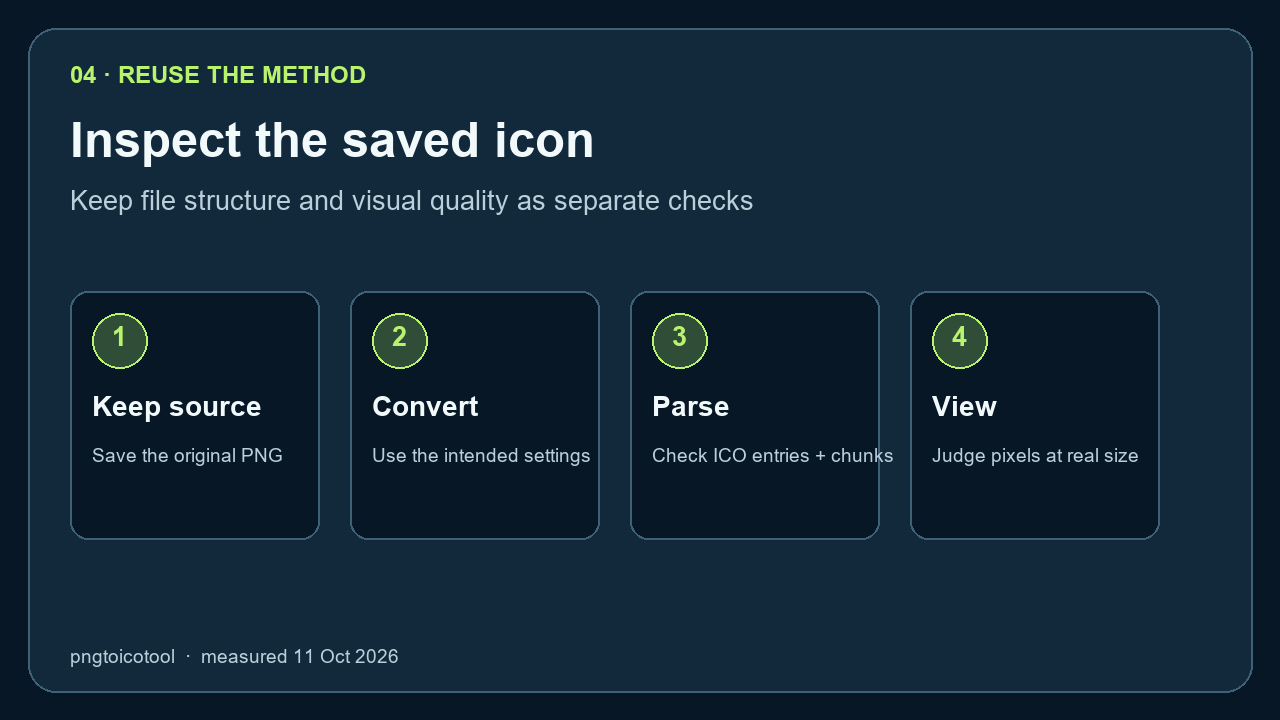
Keep your original PNG if its embedded description or physical-resolution information matters elsewhere. Convert a disposable sample with the same settings as your real artwork, download the ICO, and inspect the file directory and its embedded image bytes. Compare decoded pixels to judge visible output separately from metadata. If you need a specific color profile, EXIF tag, or other chunk in a downstream file, test that exact tag and destination instead of extrapolating from this tEXt and pHYs result.
The W3C PNG specification defines tEXt and pHYs as PNG chunks. MDN's canvas documentation explains that a canvas export creates a new image blob. Neither reference substitutes for opening the actual downloaded ICO, which is why the four source files, four ICO outputs, checksums, and parser are available below.
Reproduce the four-file result
Synthetic inputs and public-tool downloads, 11 October 2026. All six size boxes remained selected. Every result below is a measured file, not an estimated converter capability.
| Input | Input bytes | ICO bytes | ICO layers | Whole-file SHA-256 |
|---|---|---|---|---|
| plain.png | 339 | 9,564 | 16/32/48/64/128/256 | 6fd11144…26bbf0c |
| text.png | 406 | 9,564 | 16/32/48/64/128/256 | 6fd11144…26bbf0c |
| dpi.png | 360 | 9,564 | 16/32/48/64/128/256 | 6fd11144…26bbf0c |
| text-dpi.png | 427 | 9,564 | 16/32/48/64/128/256 | 6fd11144…26bbf0c |
The abbreviated digest in the table is shown in full in the answer and output CSV. Four equal digests establish byte identity for these saved outputs. The ICO parser lists each embedded PNG's chunk types in the output CSV.
FAQ
PNG metadata and ICO questions
Did changing source DPI change the icon's pixel dimensions?
No in this test. The plain and 96-DPI variants both produced the same six ICO dimensions and the same file hash. DPI is not a substitute for choosing the pixel layers you need.
Does the text description survive this conversion?
It did not appear in any embedded PNG payload from these four downloads. Keep the source PNG separately if you need its description later.
Does this prove all metadata is removed by every PNG to ICO converter?
No. We tested tEXt and pHYs only, with one tool and one settings path. ICC, EXIF, animation, private chunks, and other converters require their own tests.
Can two equal-size ICO files still differ?
Yes. Equal byte length is weak evidence; compare a cryptographic digest or inspect the contents. These four files also shared the same full SHA-256, which supports byte identity for the saved files.